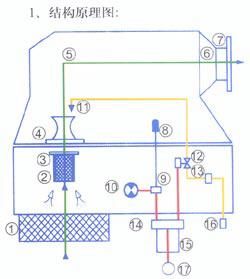
1.Structural Schematic Diagram: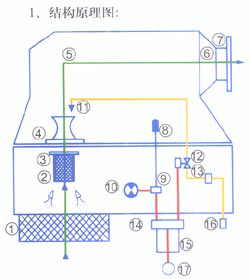
| 1. Primary Coarse Filter Box | 7.Clean Air Outlet Pipe | 13.Oil-Water Separator |
| 2.High-efficiency Filter Cartridge | 8.Negative Pressure Probe | 14.Programmable Controller (PLC) |
| 3.Sealing Gasket | 9.Negative Pressure Differential Controller | 15.Control Instrument |
| 4.Venturi Tube | 10.Negative Pressure Differential Alarm | 16.Compressed Air Inlet |
| 5.Clean Air Pipe | 11.Back-blow Air Nozzle | 17.Power Plug |
| 6.Air Collection Port | 12.Pulse Solenoid Valve | |
| A. Red line – Electrical wiring | B. Green line – Filtration process | C. Yellow line – Self-cleaning process |
2. Filtration Process
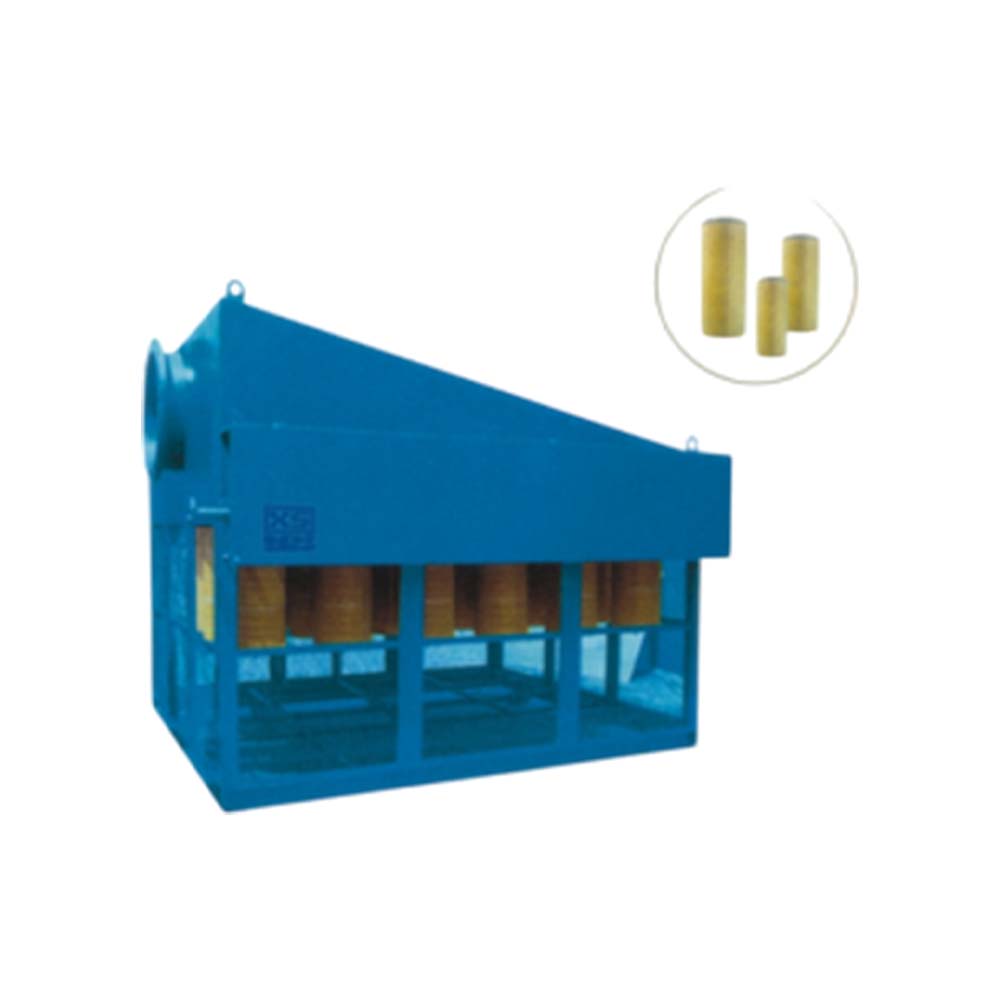
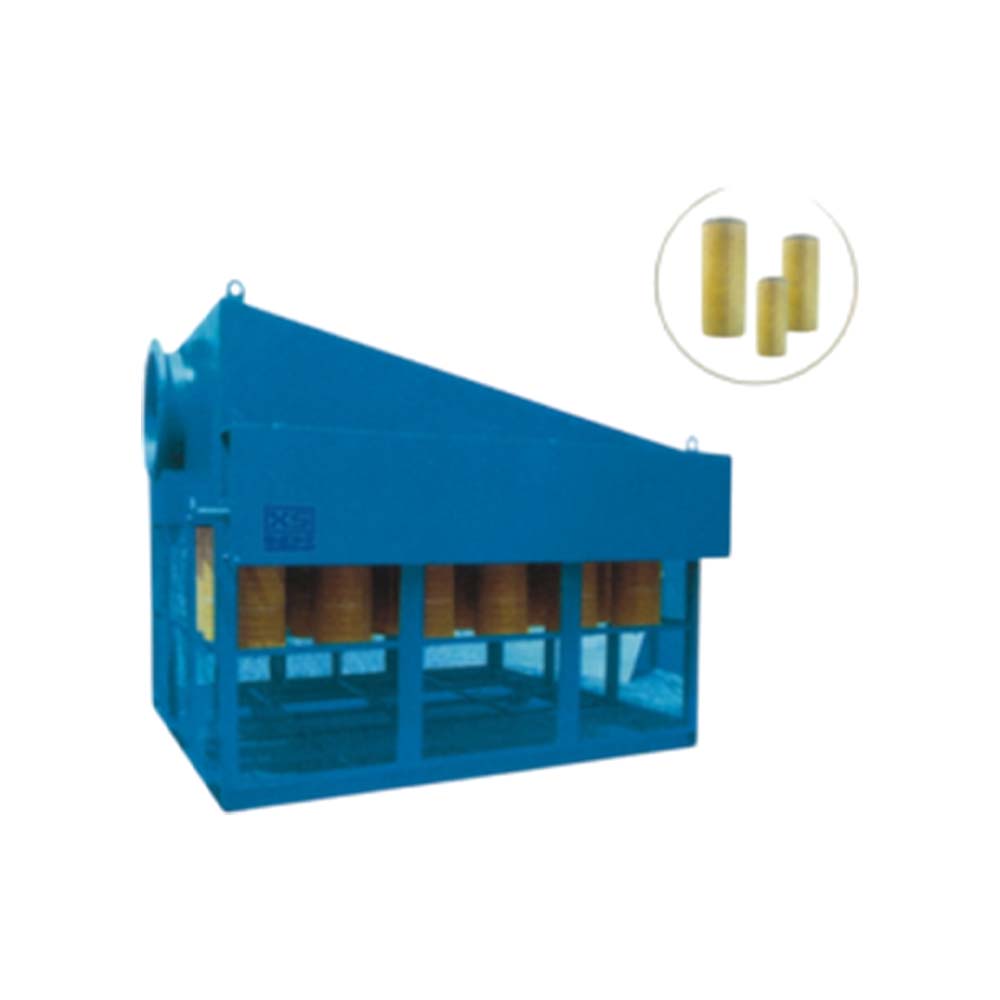
Dust-laden air is drawn in by the air compressor through the primary coarse filter box (①). It then passes through the high-efficiency filter cartridge (②), where dust is captured by a combination of gravity, inertia, diffusion, and contact retention. Clean air passes through the sealing gasket (③) into the Venturi tube (④), then enters the clean air chamber (⑤), converges at the air collection port (⑥), and is finally drawn into the air compressor through the clean air outlet pipe (⑦).
3. Self-Cleaning Process
After filtration, dust is captured on the high-efficiency filter cartridge. The PLC initiates the back-blow self-cleaning process according to the preset timing sequence. When the pressure drop exceeds 500 Pa, the PLC controls the back-blow cleaning based on the differential pressure sequence (back-blow duration: 0.1–0.2 seconds). Other high-efficiency filter cartridges continue operating normally, while the dust is removed by the back-blow cleaning.
| Serial Number | Item / Specifications | ZKL120 | ZKL180 | ZKL240 | ZKL300 | ZKL400 | ZKL560 | ZKL720 | ZKL800 | ZKL1000 | ZKL1200 | ZKL1680 | ZKL3000 | ZKL5200 | ZKL6000 | ZKL7200 | ZKL7600 | ZKL8400 | ZKL10400 | ZKL12800 | ZKL15200 | ||||
| 1 | Maximum Air Filtration Capacity (m³/min, Suction Condition) | 120 | 180 | 240 | 300 | 400 | 560 | 720 | 800 | 1000 | 1200 | 1680 | 3000 | 5200 | 6000 | 7200 | 7600 | 8400 | 10400 | 12800 | 15200 | ||||
| 2 | Structural Type | Single Layer | Double Layer | ||||||||||||||||||||||
| 3 | Initial Pressure Drop (Pa) | ≤150 | ≤250 | ||||||||||||||||||||||
| 4 | Filtration Accuracy (μm) / Efficiency (%) | ≥1/99.96 ≥2/99.99 ≥3/100 | |||||||||||||||||||||||
| 5 | Power Consumption (W) | 100 | 150 | 200 | |||||||||||||||||||||
| 6 | Power Supply (AC) | 220V | |||||||||||||||||||||||
| 7 | Back-blow Air Volume (m³/min) | 0.1 | 0.2 | 0.3 | |||||||||||||||||||||
| 8 | Back-blow Air Pressure (MPa) | 0.4-0.6 | |||||||||||||||||||||||
| 9 | Overall Dimensions (m) | Length | 1.5 | 1.5 | 2.0 | 2.3 | 2.3 | 3.1 | 3.9 | 3.5 | 4.3 | 4.3 | 6.2 | 9 | 5.5 | 6.6 | 7.8 | 8.2 | 9 | 5.8 | 7.0 | 9 | |||
| 10 | Width | 1.2 | 1.5 | 1.5 | 1.5 | 2.0 | 2.0 | 2.0 | 2.2 | 2.2 | 2.6 | 3 | 3.4 | 3.4 | 3.4 | 3.4 | 3.4 | 3.4 | 6.8 | 6.8 | 6.8 | ||||
| 11 | Height | 2.8 | 2.8 | 2.8 | 2.8 | 2.8 | 2.8 | 2.8 | 2.8 | 2.9 | 2.9 | 2.9 | 4.25 | 6.75 | 6.75 | 6.75 | 6.75 | 6.75 | 6.75 | 6.75 | 6.75 | ||||
| 12 | Number of Modules | 1 | 1 | 1 | 1 | 1 | 1 | 1 | 1 | 1 | 1 | 1 | 1 | 2 | 2 | 2 | 2 | 2 | 4 | 4 | 4 | ||||
| 13 | Weight (t) | 1 | 1.5 | 2 | 2.5 | 3 | 4.0 | 4.5 | 5.0 | 5.5 | 6.0 | 7 | 12 | 22 | 24 | 29 | 31 | 34 | 42 | 52 | 61 | ||||
Note: