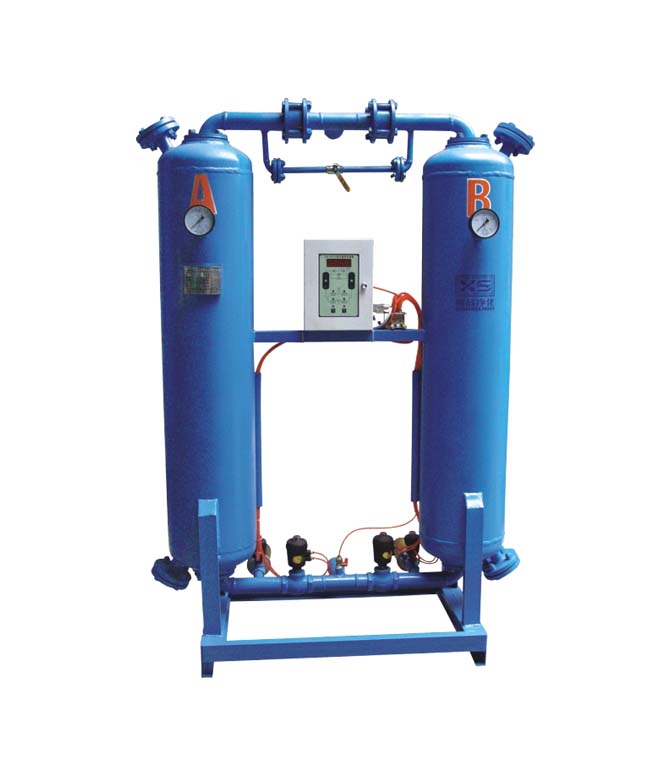
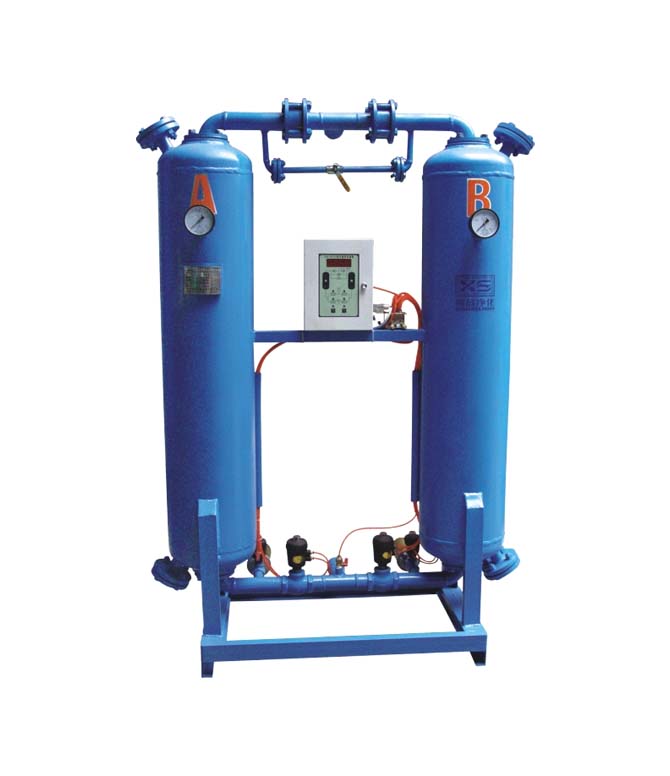
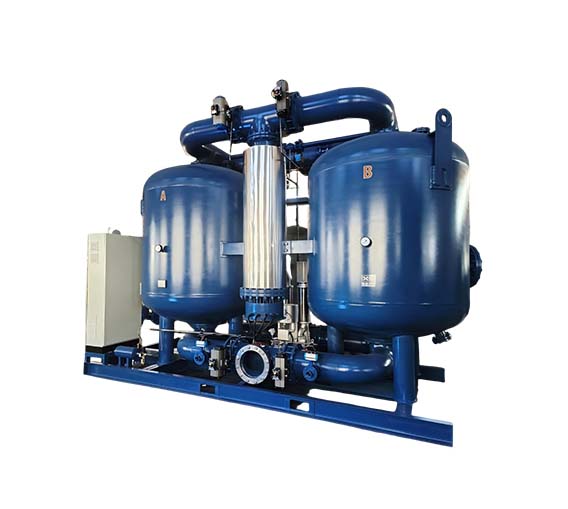
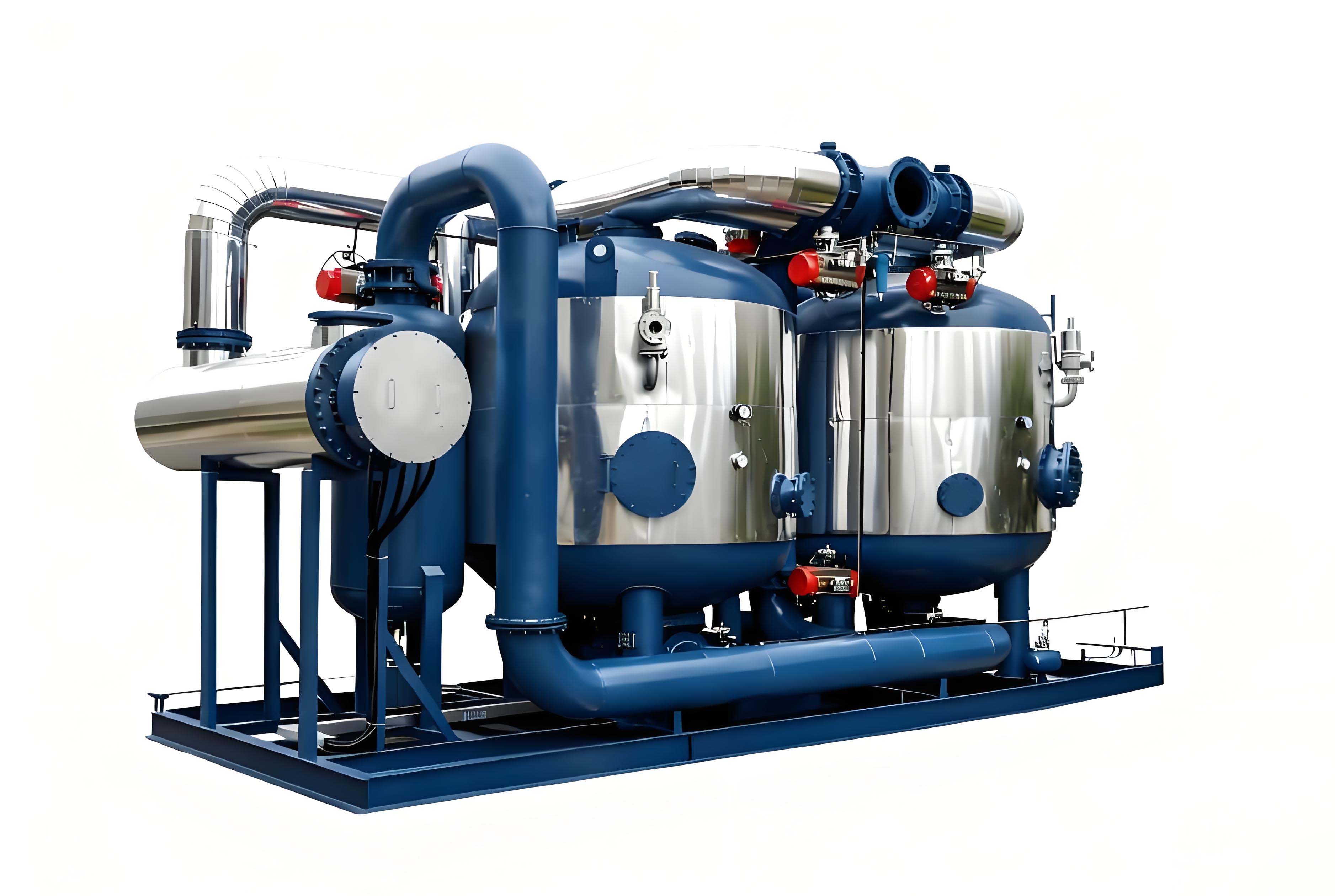
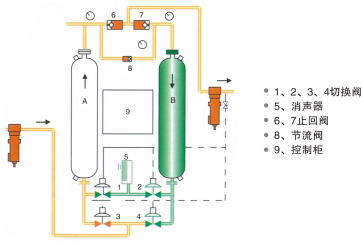
Process flow diagram
Product Features
- Stable and consistent outlet pressure and dew point
- The height and diameter of the adsorption tower are precisely calculated based on experimental results, ensuring low bed resistance and a 5-second contact time between compressed air and desiccant to meet the required product air dew point.
- A 30% desiccant reserve compensates for natural aging, ensuring long-term drying performance.
- A large diffuser ensures uniform airflow through the desiccant bed, eliminating channeling.
- Regeneration air loss less than 14%
- Excellent vessel design retains 100% of adsorption heat. The stored heat increases the regeneration air temperature during desorption, enhancing regeneration efficiency and ensuring complete desorption.
- A counterflow design is adopted for drying and regeneration — the drying effect is optimal when moist air passes through the dry desiccant layer. The outlet regeneration air remains in a sub-saturated state, preventing condensation in the silencer and exhaust path.
- The regeneration air volume can be adjusted based on dryer load requirements, ensuring continuous and stable flow while maintaining regeneration pressure near the critical point.
- Long desiccant lifespan
- Optimized tower dimensions ensure the gas velocity and contact time through the desiccant bed remain ideal, maximizing desiccant performance.
- Proper system configuration removes oil and heavy contaminants from the airflow via high-efficiency oil separators before entering the tower, preventing desiccant contamination.
- The unit uses high-quality activated alumina, offering high strength, low dust generation, stable dew point, and long service life.
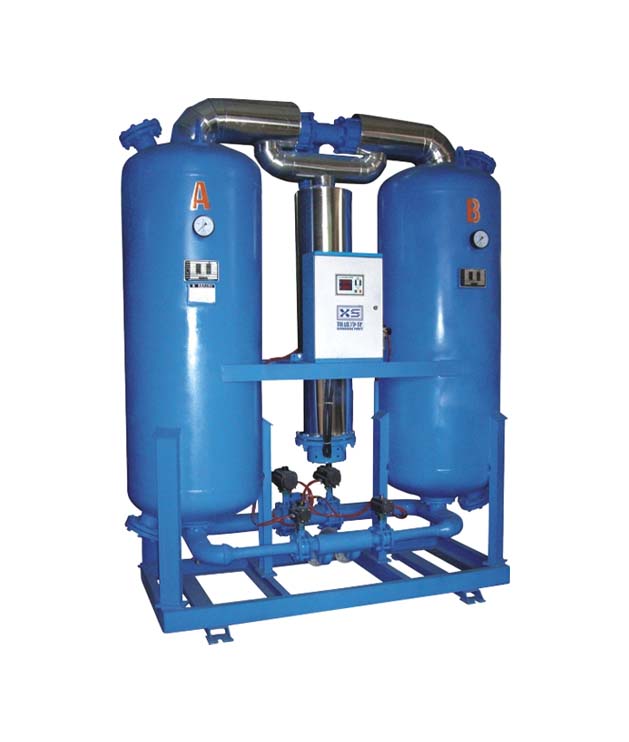
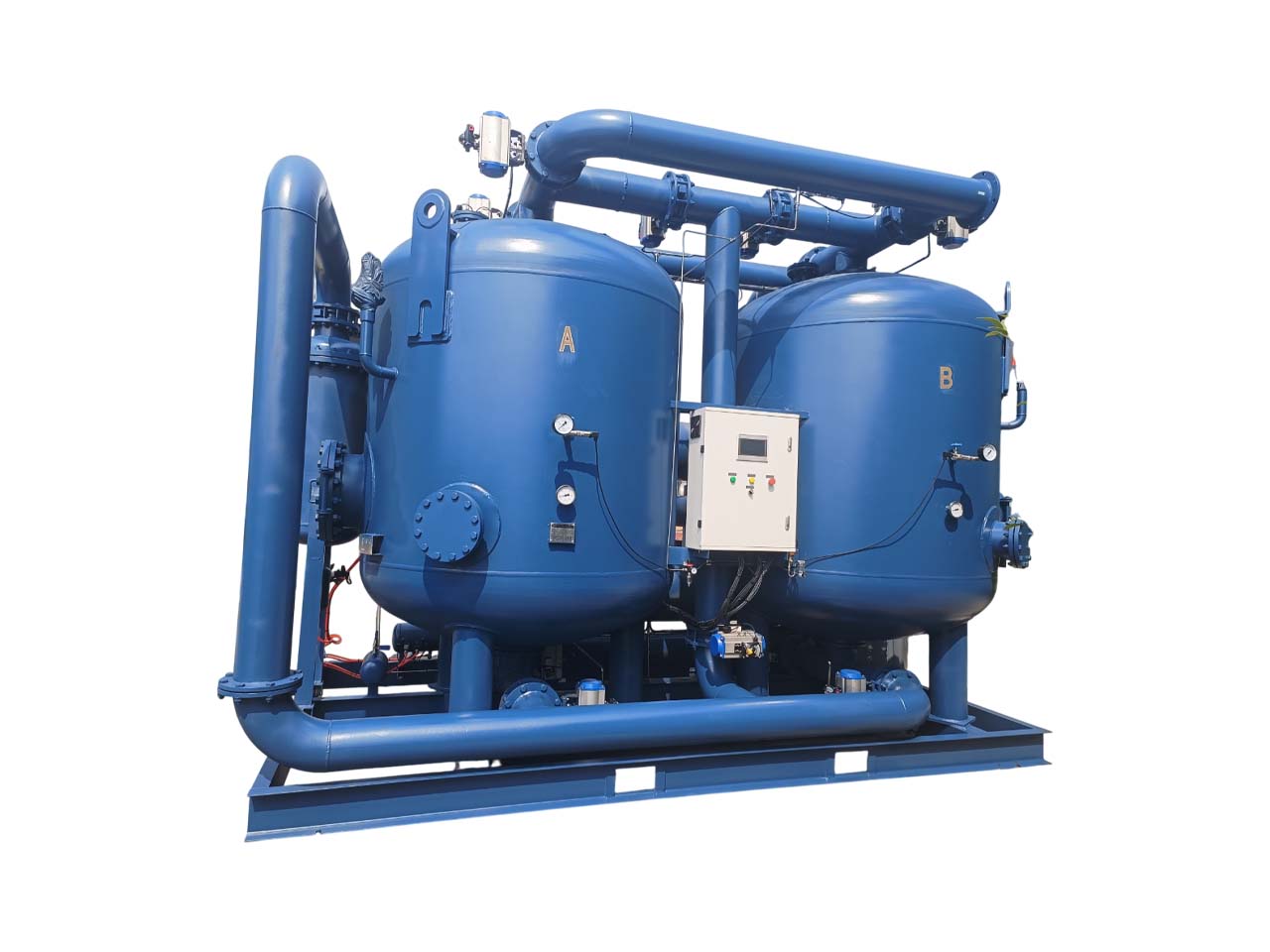
- The equipment adopts high-quality pneumatic valves and a reliable fully electronic programmable controller with a user-friendly interface. It continuously displays dual-tower operating status, allows on-site cycle adjustment, and has a factory setting of 10 minutes. Valve lifespan reaches up to 500,000 cycles.
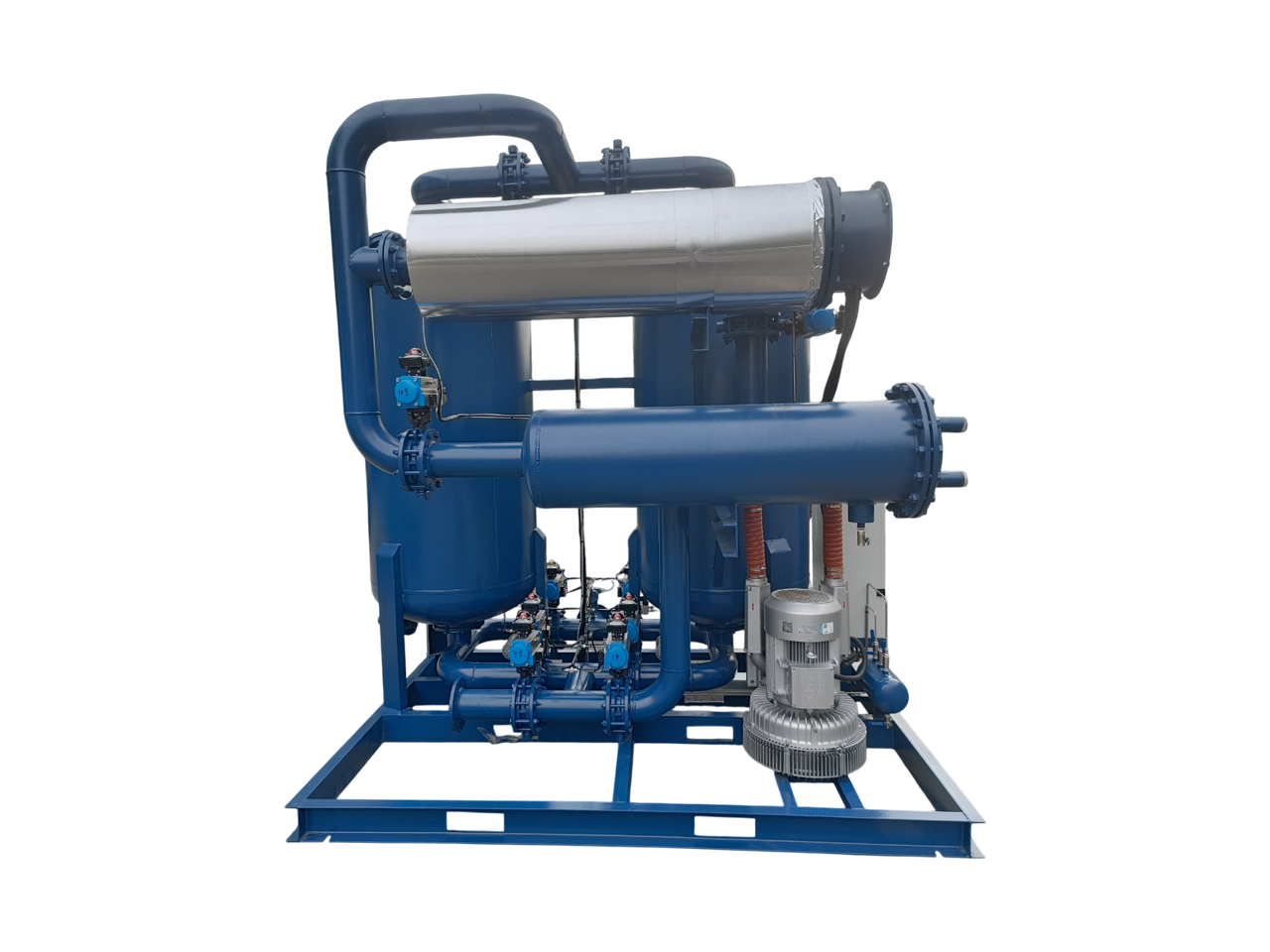
- Accurate operation, stable performance, easy operation, and no foundation installation required.
Technical Parameters
- Rated Inlet Temperature: ≤45℃
- Rated Operating Pressure: 0.7 MPa (usable range 0.4–1.0 MPa; up to 6.4 MPa available on request)
- Pressure Drop: <0.02 MPa
- Pressure Dew Point: -40℃ (at 0.7 MPa) (-70℃ available on request)
- Regeneration Method: Heatless regeneration
- Control Method: Fully electronic programmable timer control or PLC control
- Working Cycle: T = 10–60 minutes (adjustable)
- Regeneration Air Consumption: Approx. 13%–15%
- Desiccant: Activated alumina
- Inlet Air Oil Content: ≤0.1 ppm
- Installation: Indoor, no foundation required, leveled concrete floor
Model Specifications and Performance Parameters
| Model XS- | 06WXF | 1WXF | 2WXF | 3WXF | 6WXF | 8WXF | 10WXF | 12WXF | 15WXF | 20WXF | 25WXF | 30WXF | 40WXF | 50WXF | 60WXF | 80WXF | 100WXF | 120WXF | 150WXF | 200WXF | 250WXF | 300WXF | 350WXF | 400WXF |
| Nominal Volume Flow Rate(m3/min) | 0.6 | 1.2 | 2.6 | 3.8 | 6.8 | 8.5 | 11 | 13 | 17 | 22 | 27 | 32 | 42 | 55 | 65 | 85 | 110 | 130 | 160 | 210 | 260 | 310 | 360 | 410 |
| Piping Size | RC1/2″ | RC1″ | RC1″ | RC11/2″ | RC11/2″ | RC2″ | RC2″ | RC2″ | DN65 | DN80 | DN80 | DN80 | DN100 | DN100 | DN125 | DN125 | DN150 | DN150 | DN200 | DN200 | DN200 | DN250 | DN300 | DN300 |
| Weight(Kg) | 80 | 110 | 150 | 160 | 350 | 430 | 460 | 520 | 720 | 890 | 950 | 1320 | 1550 | 1880 | 2250 | 2810 | 4150 | 4980 | 6250 | 7280 | 9360 | 13000 | 13600 | 14390 |
| Length(mm) | 620 | 850 | 850 | 950 | 970 | 1175 | 1230 | 1320 | 1420 | 1310 | 1460 | 1660 | 1710 | 1920 | 2050 | 2100 | 2300 | 2620 | 2850 | 3000 | 3500 | 4200 | 4400 | 4700 |
| Width(mm) | 400 | 400 | 400 | 450 | 450 | 500 | 550 | 570 | 700 | 700 | 750 | 850 | 850 | 950 | 1050 | 1050 | 1150 | 1150 | 1350 | 1500 | 1780 | 2000 | 2200 | 2400 |
| Height(mm) | 1137 | 1694 | 1894 | 1480 | 1852 | 1965 | 2040 | 2100 | 2250 | 2480 | 2500 | 2550 | 2600 | 2640 | 2850 | 2840 | 2800 | 2860 | 3040 | 3200 | 3290 | 3600 | 3650 | 3800 |
Note:
Optional Configurations
1. Integrated installation of pre- and post-filters on the main unit (modular design).
2. Use of molecular sieve desiccant.
3. Dew point switching control mode.
4. High dew point alarm, interlock protection, and upper-level communication interface.
5. Equipped with imported dew point meter with LCD or touchscreen display.
6. PLC control system compatible with multiple communication protocols, including RS485 I/O, Profibus, Modbus, and Ethernet.