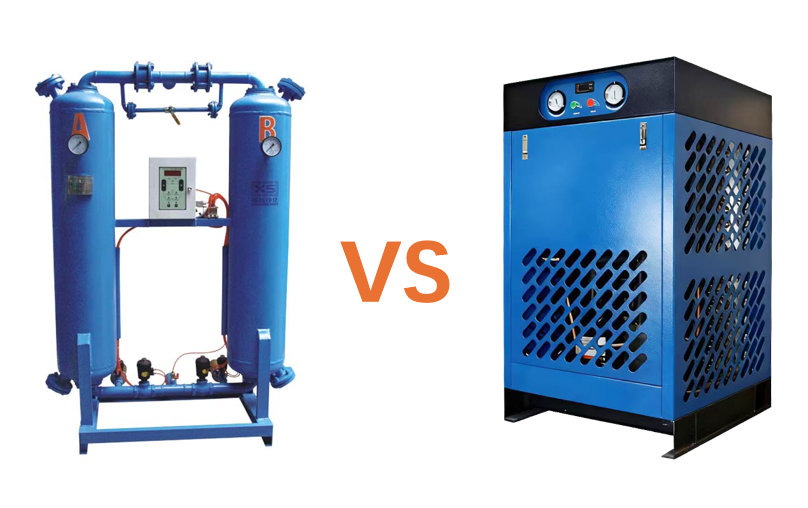
When selecting air dryers for industrial compressed air systems, the two most commonly compared technologies are adsorption air dryers (also known as desiccant air dryers) and refrigerated air dryers. Both are designed to remove moisture from compressed air, but they work very differently, use different technologies, and achieve different dew points. Understanding how each dryer works is essential for choosing the right model for your application, energy consumption needs, and overall cost effectiveness.
In this guide, we compare adsorption air dryers and refrigerated air dryers in detail — including working principles, dew point performance, operating costs, desiccant material types, and best-fit applications.
An adsorption air dryer uses desiccant material—such as activated alumina, silica gel, or molecular sieve—to adsorb water vapor from compressed air. Instead of cooling the air, the desiccant physically attracts and holds moisture molecules.
This type of dryer is the best choice when your compressed air system requires extremely dry compressed air with very low dew points, typically –40°C to –70°C.
This regeneration process is why desiccant dryers offer low dew points but may consume more energy depending on the design.
A refrigerated air dryer reduces moisture by cooling the compressed air using a refrigeration circuit. When the temperature drops, water vapor condenses, allowing the system to remove liquid water before the air is reheated and sent downstream.
Refrigerated dryers provide dew points around 3°C to 10°C, which is suitable for most industrial compressed air systems that do not require ultra-dry air.
Refrigerated air dryers are reliable, cost effective, and energy efficient for general industrial use.
If your application requires very low dew points (instrumentation, painting, pharmaceuticals), adsorption dryers are essential.
✔ You need ultra-low dew points (–40°C or below)
✔ Your process involves pharmaceuticals, electronics, medical devices, instrumentation
✔ Ambient air conditions require extremely dry compressed air
✔ Moisture could damage product quality
✔ You need reliable moisture removal for everyday industrial use
✔ Cost effectiveness and energy efficiency are priorities
✔ Your facility uses standard pneumatic tools and general compressed air systems
In short:
| Feature | Adsorption Air Dryer | Refrigerated Air Dryer |
|---|---|---|
| Working Principle | Desiccant adsorbs water vapor | Refrigerated air condenses moisture |
| Dew Point | –40°C to –70°C | 3°C to 10°C |
| Energy Use | Medium to high | Low |
| Maintenance | Desiccant replacement | Refrigerant maintenance |
| Purge Air Required | Yes (except zero-purge) | No |
| Best For | High-precision industries | General compressed air applications |
| Cost Effectiveness | Higher operating cost | Very cost effective |
Refrigerated air dryers are generally more energy efficient because they do not require purge air or desiccant regeneration.
Adsorption air dryers provide the lowest dew points, often reaching –40°C to –70°C.
Not always. Some models use heated blower regeneration, reducing or eliminating purge air consumption.
Adsorption air dryers are better when moisture can damage process quality, such as in painting, electronics, pharmaceuticals, and instrumentation.
Yes, but they may be less effective in extremely cold environments if dew point falls below freezing.
Both adsorption air dryers and refrigerated air dryers are essential technologies for modern compressed air systems. The best choice depends on dew point requirements, operating costs, air quality standards, and the needs of your production process.
Selecting the right dryer ensures stable system performance, protects equipment, and maintains product quality.